 Viewed: 52
This article is translated from the Chinese-language original of
Commentary on China's Wine Industry, Volume 1.
In discussions about Chinese wine consumption, the industry often focuses on scores, awards, and high-end expression. Yet what truly determines everyday consumption is a much more basic question: how much should a bottle of wine cost before people are willing to buy it regularly?
Here, “everyday choice” does not refer to the highest quality or the highest score, nor does it simply mean the lowest price. It refers to a bottle that can be repeatedly purchased in ordinary life without hesitation. If every purchase requires careful comparison or psychological justification over the price, the wine will struggle to enter consumers’ everyday shopping list. It will also find it difficult to become their default choice. A true everyday wine is never simply the cheapest bottle. It is the bottle that needs the least explanation.
In mature wine markets, this question is not vague.
Public market data and industry analysis show that in the U.S. retail market, wines priced below USD 10 have been under pressure, while mid-priced products have performed relatively more steadily. This suggests that, at the level of everyday consumption, consumers are gradually moving away from extremely low-priced wines and toward choices with more predictable prices and more stable quality.
Within this structure, the USD 10–15 range, roughly equivalent to RMB 70–110, has gradually become a price band that balances affordability and consumer confidence. It is not a high-end consumption range, nor does it depend on heavy discounts. Rather, it is closer to an everyday choice that feels safe and unlikely to go wrong. For this reason, it is better able to support repeated purchases and the formation of consumption habits.
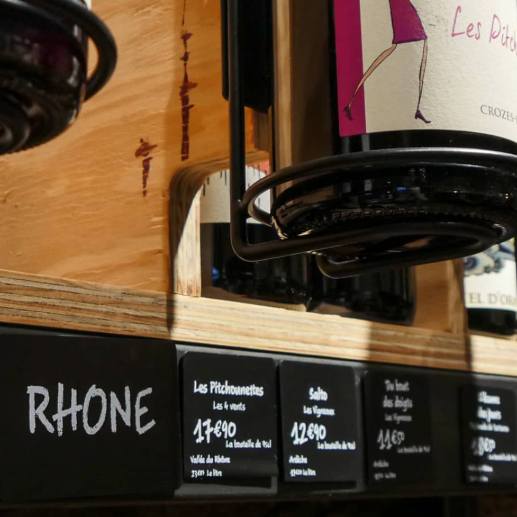
The structure of the French market is also relatively clear. In French supermarkets, wines priced at around one euro do exist. However, these products mainly serve a minimum-cost consumption function and do not represent the mainstream choice for everyday bottled wine. The wines that ordinary households frequently purchase and that form the core of daily consumption are mainly concentrated in the EUR 2–8 range, roughly equivalent to RMB 15–60. Among them, wines priced at EUR 2–5, or about RMB 15–40, serve the function of entry-level daily drinking, while wines priced at EUR 5–8, or about RMB 40–60, constitute the most common table wine choices.
This is not simply a matter of cultural difference. It is a matter of whether the consumption structure is mature enough. From the U.S. range of USD 10–15 and the French range of EUR 2–8, we can see that the price of an everyday wine in a mature market is not determined by the lowest possible price. It is determined by whether there is a price band that consumers can repeatedly confirm without too much judgment.
These price bands share one essential feature: they are neither so expensive that consumers feel regret after buying, nor so cheap that consumers assume the wine must be low-quality and uninteresting.
When this logic is brought back to the Chinese market, the problem becomes particularly clear.
China does not lack affordable wine products. However, a broadly recognized everyday price band that supports repeated purchase has not yet taken shape. In reality, China’s wine price structure has long been squeezed at both ends. Some products are pushed upward into the mid-to-high-end range, where they carry image, status, and symbolic expression. Others are forced downward into unstable low-price segments, where they depend heavily on promotions and are difficult to sustain over the long term. The middle range, which is most suitable for repeated purchase and habit formation, has remained underdeveloped.
This also explains a common phenomenon. Consumers’ confusion about Chinese wine does not come entirely from whether the price is high or low. More often, it comes from the fact that they cannot understand what different price points actually mean. They also lack a reassuring starting point from which they can begin with confidence.
Based on the experience of foreign markets, a price band capable of forming an everyday consumption relationship needs at least three conditions. First, the price must remain stable over time rather than appearing only through occasional discounts. Second, the consumption outcome must be predictable; consumers should know before buying that the bottle is unlikely to disappoint. Third, the cost of judgment must be low enough that consumers do not need to weigh the decision repeatedly.
Yet another premise is often overlooked: the default bottle itself must have reliable and stable quality. The cheaper a wine is, the easier it is to buy regularly only when its quality remains predictable. Once quality becomes uncertain, a low price will not encourage repeat purchase. Instead, it may interrupt it.
Considering the everyday consumption structures of the U.S. and French markets, as well as China’s current purchasing power, channel costs, and market environment, a relatively clear judgment can be made: if Chinese wine is to truly enter everyday consumption, the more viable price range is likely to fall between RMB 60 and RMB 120 for a 750 ml bottle.
This price range does not mean lowering standards. It means that, under an affordable price condition, the quality of the default bottle must be consistently reliable. When consumers repeatedly receive an experience that is at least not disappointing within this price range, price can gradually turn into trust, and trust can gradually turn into habit.
It should also be emphasized that the problem does not lie only in price itself. In reality, Chinese wines priced at around RMB 80 or RMB 90 do exist. The issue is that these wines often have very low visibility in everyday consumption scenarios. They may be available through winery direct sales, regional channels, or specific online platforms, but they rarely appear consistently on the shelves that consumers pass by most frequently.
At the same time, limited retail and communication resources are highly concentrated on a small number of leading brands. As a result, even when other Chinese wines already meet the conditions of everyday drinking in terms of both price and quality, they still struggle to gain sustained exposure.
The premise of becoming an everyday choice is never only the first recommendation. It is whether the second and third purchases can be made easily. When a bottle of wine has to be deliberately searched for, or when consumers need to remember where they bought it last time, it has already lost the conditions required to become a default choice.
Under a market structure in which exposure is highly concentrated among leading brands, it is difficult for new everyday choices to find enough space. The default bottle, therefore, cannot be naturally renewed.
What Chinese wine truly needs to make up for at this stage is not another upward proof of how good it can be. It first needs to answer a realistic question from below: is there a bottle of wine that is reasonably priced, consistently reliable in quality, and repeatedly visible to consumers?
When such a bottle appears, it will naturally become a default choice. And when the default choice appears, Chinese wine will finally begin to enter everyday life.
References
U.S. Bureau of Labor Statistics. (n.d.). Average Price: Wine, Red and White Table, All Sizes, Any Origin (Cost per 1 Liter/33.8 Ounces) in U.S. City Average [APU0000720311]. FRED, Federal Reserve Bank of St. Louis. Retrieved April 28, 2026, from https://fred.stlouisfed.org/series/APU0000720311
U.S. Bureau of Labor Statistics. (n.d.). Consumer Price Index for All Urban Consumers: Alcoholic Beverages in U.S. City Average [CUSR0000SAF116]. FRED, Federal Reserve Bank of St. Louis. Retrieved April 28, 2026, from https://fred.stlouisfed.org/series/CUSR0000SAF116
FranceAgriMer. (2025, December 24). Achats et ventes de vins tranquilles. FranceAgriMer. https://www.franceagrimer.fr/chiffre-et-analyses-economiques/achats-et-ventes-de-vins-tranquilles
FranceAgriMer. (2019, October). Évolution des achats de boissons alcoolisées par les ménages français pour leur consommation à domicile, entre 2008 et 2017. FranceAgriMer. https://www.franceagrimer.fr/chiffre-et-analyses-economiques/evolution-des-achats-de-boissons-alcoolisees-par-les-menages
Persistence Market Research. (n.d.). Wine Market Size and Trends Analysis. Persistence Market Research. Retrieved April 28, 2026, from https://www.persistencemarketresearch.com/market-research/wine-market.asp
International Organisation of Vine and Wine. (2025). State of the world vine and wine sector in 2024. OIV. https://www.oiv.int/sites/default/files/documents/OIV-State_of_the_World_Vine-and-Wine-Sector-in-2024.pdf
Author's Bibliography
Currently as a doctoral candidate. Shumeng Dong is e works at the Marketing Teaching and Research Office, College of Wine Science, Northwest A&F University. She serves as a consultant for the Wine Culture and Tasting Center of Northwest A&F University, Deputy Secretary-General of the Wine Professional Committee of the Chinese Poetry and Wine Culture Association (a national first-level professional social organization), a lecturer at the Queen Mary Engineering College of Northwestern Polytechnical University, the MBA & EMBA Center of Xi'an Jiaotong University, and a practical lecturer for the CBL program at EM Lyon Business School. She graduated from the Burgundy School of Business in France, majoring in International Trade of Wines and Spirits. She has participated in compiling the 14th Five-Year Plan general higher education undergraduate planning textbook Wine Hygiene, the special project World Wine Classification under the Development and Reform Program of the Ministry of Science and Technology, and other works. She has published multiple papers and presided over a number of teaching reform projects such as "Curriculum Construction of Wine Marketing and Quality Improvement of Talent Training".